

Unlock Maximum Plant Growth with NPK Foliar Spray: The Ultimate Guide
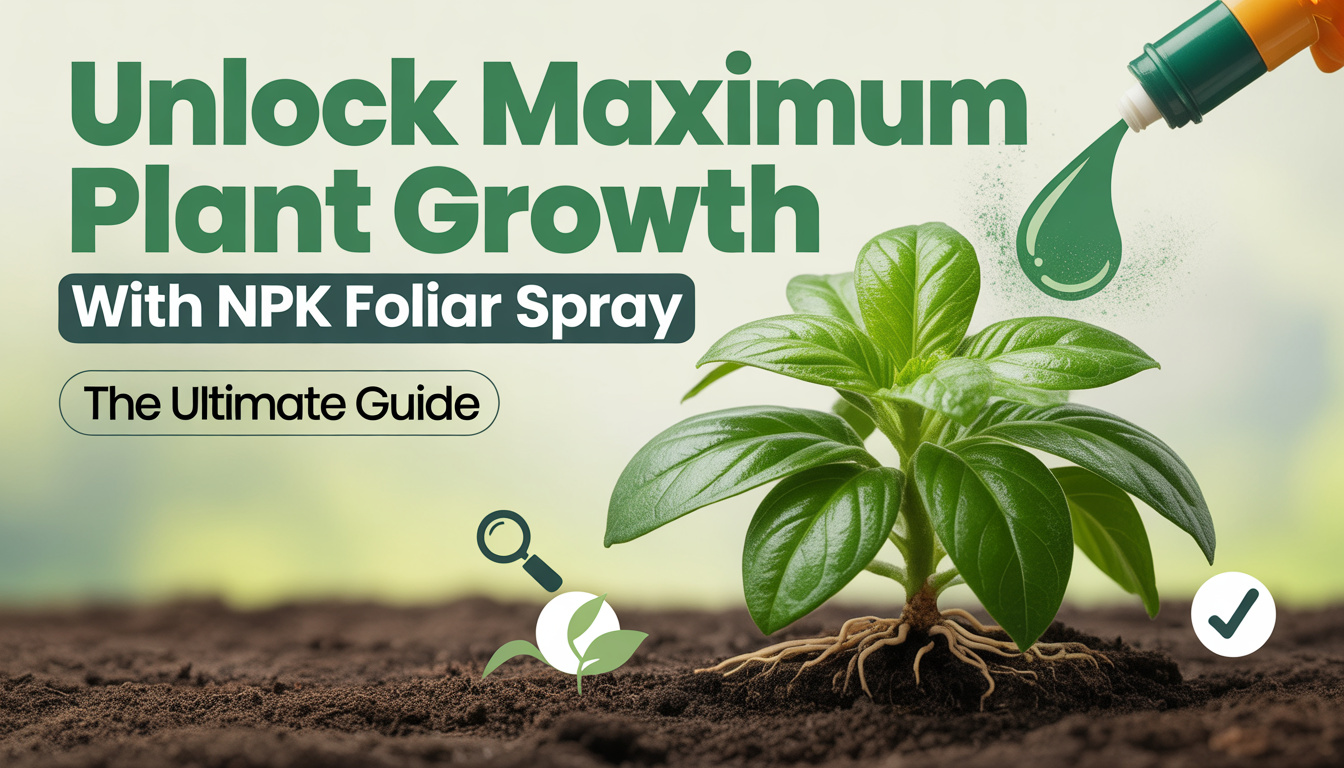
Just as traditional grains nourish the body, plants require an appropriate combination of minerals to grow strong, healthy, and achieve maximum plant production. NPK foliar spray is an effective and fast method of plant nutrition that delivers essential macronutrients—Nitrogen, Phosphorus, and Potassium—directly through the leaves. The key value is that nutrients are absorbed faster through the plant leaves than soil application. Hence, they act fast to increase plant growth, correct nutritional deficiencies, or enhance plant growth response and plant health. Nutrient-rich plants grow well even when enduring some level of heat or other environmental stresses.
Nitrogen contributes to lush green leaf growth, Phosphorus reinforces decent roots and flowering plant growth, and Potassium helps produce disease resistant and high-quality fruit and flowering plant growth. When these nutrients are combined (in the appropriate nutrient ratio) and sprayed directly to the plant foliar, they act fast and become effective—exactly like feeding plants a nutritious meal when they are hungry and they digest it instantly!
One of the key benefits of foliar feeding is immediacy. Foliar feeding should not be confused with soil application of nutrients, because soil nutrients must travel through the soil and absorption, adverted from the soil to the root and up to the shoot of the plant and then, to the leaves. Leaving behind unnecessary waiting time for the plant nutrients to be absorbed through the plant roots. Foliar feeds allow leaves to absorb the NPK nutrient solution in a matter of minutes instead of relying on soil movement to transport nutrients—and thus speeds recovery time for nutrient deficiency, plant stress, or improvement time to initiate plant growth response. Gardeners and farmers typically see results sooner and to greater effect with this method of both growing and feeding plants!
What is NPK Foliar Spray and Why Does Your Garden Need It?
In the same way that babies require easily-digestible food to encourage healthy growth, plants also benefit from a fast-acting nutritional supply. NPK foliar spray is a liquid fertilizer that provides immediate access to Nitrogen (N), Phosphorus (P), and Potassium (K) for plants, in a formulation that is applied and absorbed through the leaves, providing instant nourishment.
Foliar spraying is a powerful solution for stimulating plant health, increasing growth rates, and even correcting nutrient deficiencies in the fastest way possible, since plants can absorb nutrients 8–10 times faster through their leaves rather than through their roots. When the right foliar sprayer is applied, foliar feeds have the ability to penetrate deep into leaf tissue in a short period of time, which in turn helps keep your garden green, healthy, and productive.
NPK Foliar Spray Definition and Its Role in Plant Nutrition
NPK foliar spray fertilizer is a proportioned mixture of essential nutrients that is designed in liquid form for spray applications to the leaves of plants.
How It Works
Leaves have small ports known as stomata that can drink in nutrients when the leaves are sprayed with fine mist.
This is what makes foliar feeding:
- Faster than an application through soil
- Easier for struggling plants
- More efficient for correcting deficiencies
- Good insurance during flowering, fruiting and stress
- Why It Matters for Plant Nutrition
Plants that receive nutrition through both soil and foliar route are able to grow:
- Healthier
- More resilent
- More productive
NPK foliar spray fertilizer makes sure your plants are getting what they need even when soil nutrients are low.
Key Benefits of Using NPK Foliar Spray for Your Garden
As various millets may assist infants in distinct manners, so too does each nutrient in an NPK foliar spray serves a specialized purpose in developing the plant.
✔ 1. Quick Fix for Nutrients
Plants take up foliar nutrients in almost no time at all, which makes it perfect for;
- Yellowing foliage (nitrogen deficiency)
- Lack of root growth (phosphorus deficiency)
- Weak stems and low flowering (potassium deficiency)
✔ 2. Helps Growth and Greenness
Balanced NPK will provide opportunities for;
- Thriving leaf production
- Strong stems
- Healthy roots
- A great deal of flowering and fruit setting
✔ 3. Work even if the soil is poor
Hard, dry, sandy or saline-affected soil limits plant uptake.
Foliar feeding allows you to bypass this issue.
✔ 4. A boost to flowering and fruiting
Regular spraying will improve;
- Size of fruit
- Number of blooms
- Color, taste and quality of flavor
✔ 5. More immediate and effective than soil application.
Less fertilizer is wasted via soil uptake because it's direct.

Why Rapid Nutrient Absorption Matters for Plant Health
Similar to light, easily absorbed nutrition quickly generates energy in babies and a plant reacts quickly when nutrients enter the plant's leaf surface.
1. Quicker Noticeable Results
You can expect graphically results within 24–48 hours, including:
- Green leaves
- Less yellowing
- Improved leaf ripeness
- Stronger stems
2. Stress Conditions
Foliar feeding functions well in stressful situations, such as:
- Heat stress
- Lack of water
- Pest issues
- Transplant stress
3. Continuous Growth
When soil loses its nutrients due to wind or rain or over watering npk foliar feeding prevents any lack of nutrition to your plant.
4. Emergency Recovery
If your plant is declining or you see visual symptoms of deficient nutrition, use foliar spray as an emergency first-aid nutritional source.
The Science Behind NPK: Understanding Nitrogen, Phosphorus, and Potassium
Just as myriads of millets feed babies differently, each part of NPK performs a special role in getting plants growing and becoming strong and healthy. Collectively, in every npk foliar spray fertilizer, these nutrients complement one another to provide balanced nutrition via the leaves to plants more quickly. And if applied with the best foliar sprayer, these nutrients can be very quickly absorbed, which promotes growth, strength, and yield.
Below is a long discussion of how each nutrient works, just like the millet-explanation format.
Nitrogen’s Role in Promoting Leaf and Stem Growth
Nitrogen is to plants what Ragi is to a baby—packed with important "growth nutrients" that create strong, healthy foliage.

Nitrogen is extremely important for leafy growth. It can help plants create lush, green leaves and strong, sturdy stems, just as Ragi helps a baby develop a stronger body. When nitrogen is used as an npk foliar spray, nitrogen moves rapidly into leaf cells, and you see the immediate dark green color and leaf size increase. Plants exhibiting yellow leaves or slow growth, will respond very quickly to nitrogen-rich foliar feeding. For best nitrogen absorption as well as even coverage for spraying, gardeners typically use the best foliar sprayer as it will create a fine mist to spray all leaf surfaces evenly.
How Phosphorus Supports Root Development and Flowering
Just like Foxtail millet, phosphorus strengthens root growth, enhances energy efficiency, and improves plant health.
Reasons why plants need phosphorus
- Establishes strong root structures, especially in young plants
- Promotes flowering so flowers will bloom properly
- Improves seed formation and fruit setting
- Assists in energy transfer in the plant (ATP)
How phosphorus works
Phosphorus helps plants to form strong roots the same way good carbohydrates support the developing body of a baby. It greatly assists in the conversion of sunlight to usable energy in the plant and aids in the development of buds, flowers, and fruits. When phosphorus is deficient in the plant, it will result in poor flower structures, delay flowering, and poorly developed root systems. Using an ***N-P-K*** foliar spray fertilizer containing phosphorus can correct most deficiencies quickly. Phosphorus is very stable in the soil with very low mobility in the soil, so applying it through the leaf is the fastest way to see reactions in the plant. That is why foliar feeding is very important, especially during early developmental and flowering stages.
The Importance of Potassium for Plant Strength and Disease Resistance
Potassium, which is comparable to Barnyard or Kodo millet, develops resilience, immunity, and strength.

How Potassium Works
Potassium works as a natural defender for plants. It strengthens the stems, the immunity, and the fruit set, similar to improving a child's immunity and digestion with iron-rich millets. Potassium controls what plants do with water, making them more tolerant to conditions of heat and inadequate moisture. Through plant absorption in an npk foliar spray, potassium will also move quicker to areas of strength. Using the best foliar sprayer will allow the plant to utilize every droplet of nutrient by providing the best possible uniform coverage.
How to Properly Apply NPK Foliar Spray for Best Results
Similar to how you have to pick the appropriate millet to meet your infant's digestive requirements, when you utilize npk foliar spray you want to make sure you're applying it properly so it can be absorbed and fed quickly and utilized efficiently by your plants. If you are using foliar feeding properly, it is safe for your plants, fast, and very effective. Here is a full explanation of utilizing npk foliar spray fertilizer to facilitate the greatest growth rates in your plants
Correct Dilution Ratios for NPK Foliar Spray Fertilizer
Selecting the correct dilution ratio is as essential as selecting the correct type of texture of millet gruel for your babies. A properly mixed nh3k foliar spray fertilizer will help your plants absorb nutrients quickly, without stress, or leaf burn.
Why is Dilution Important?
- It helps reduce leaf burn.
- It helps deliver nutrients uniformly to the leaves, so no nutrient zone is left undelivered.
- It aids the plant in digesting nutrients more quickly.
- It prevents a build-up of salts on the leaves, as you would not always want the salts to accumulate on leaves, they'll burn the leaves.

- Always dissolve the fertilizer completely before pouring into the sprayer.
- If possible, use lukewarm water; it really helps dissolve the crystals faster.
- Always start with the mildest concentration for young or sensitive plants.
- Use the best foliar sprayer, with fine mist setting, to deliver fertilizer to plants.
Best Time of Day to Apply NPK Foliar Spray
Like all millets vary for babies based on age, the timing of application for npk foliar spray impacts plant absorption and safety.
Optimal Spray Times
- Early Morning (6 am - 9 am)
- Cool weather equals faster absorption of nutrients by the leaves.
- Late Evening (4 pm - 6:30 pm)
- Reduces the possibility of leaf burn and loss due to evaporation.
Why This Matters
Stomata (tiny openings) are open during cooler times --> Better absorption
Reduces any burning that could occur from the sun drying wet leaves.
Decreases evaporation of the fertilizer.
Reduces nutrient crystallization on leaves.
Avoid These Times
- Do NOT spray when direct sunlight hits the leaves --> Leaf burning.
- Do NOT spray when it is windy --> Coverage won't even.
- Do NOT spray before a rain event--> The spray will be washed off.
Using the best foliar sprayer will produce a fine, even mist to improve absorption regardless of time.
Tips for Avoiding Common Mistakes (e.g., Leaf Burn)
Similar to how feeding babies the wrong texture of millet can cause an upset stomach, using npk foliar spray fertilizer incorrectly can harm plants. Steer clear of these mistakes so foliar feeding is safe and effective.
A. Avoid Over-Fertilizing
A high concentration will cause burning of the leaves
Yellowing, browning, or curling leaves are some of the first signs of an issue.
Always start with the lowest dose possible.
B. Never Spray in Direct Sunlight
Water droplets act like a magnifying glass.
Nutrient salts will warm up and scorch the leaf.
C. Make Sure the Sprayer is Set to the Correct Nozzle
A fine mist, not droplets, is ideal for the best foliar sprayer.
Mist = absorption
Droplets = runoff + loss + possible burning of the leaf
D. Test Spraying a Small Area First
Alike to introducing lump millet to babies one at a time, test spraying a small portion of the plant before spraying a full-plant application.
E. Clean the Leaves First
Dust on the leaves will block nutrient absorption and soil nutrients to the leaves.
You may use clean water to rinse the leaves before foliar feeding as needed.
F. Never Mix With A Strong Pesticide
Mixing the npk foliar feeding fertilizer incorrectly can crown a few issues:
Toxicity to the leaves
Locking out nutrients
Plant stress

NPK Foliar Spray vs. Traditional Soil Fertilizers: Which Delivers Better Results?
Just like babies require various millets at different stages of life, the plants need nutrients as forms they can uptake. NPK foliar spray is able to provide rapid nourishment through the leaves, while soil fertilizers will feed plants gradually through the roots. Both processes promote plant growth, but in very distinct ways. The following is a well-formatted, concise approach to help you examine which option effectively performs better, and when.
Faster Nutrient Uptake with Foliar Feeding
Foliar feeding can be seen as an energy boost for the plant - foliar feeding or foliar spray means you give the nutrients directly to the leaves, so the nutrient drips right down onto the leaves and doesn't need to wait for the soil to do the work.
When you foliar spray or use an npk foliar spray fertilizer, the nutrients will enter through the stomata or exudates (wetness) within minutes of foliar application, meaning they can instantly, or independently, take in Nitrogen, making the leaves greener; phosphorus, making the roots stronger; potassium, making the plant resistant to disease; etc. This process is valuable when the plant or roots are under a stress response (i.e., heat, rain damage, no soil presence or capability) when the roots may not have the capacity to effectively uptake soil nutrients. Using the best foliar sprayer type implements a fine, misty, even, and coverage coating every leaf surface for maximum absorption.
Key Points
- Works 8–10 times faster than soil application.
- Corrects a nutrient shortage immediately.
- Useful when there is heavy rain, root damage, compacted soil.
Very little wasted nutrient because the nutrient goes directly into the plant rather than sitting in the soil.
Why Foliar Sprays Are Ideal for Correcting Nutrient Deficiencies
As certain millets aid with iron, energy, or digestion, npk foliar spray provides nutrients directly to an unhealthy plant and satisfies the plant's nutrient deficiency quickly and efficiently.
If you observe your plant is yellow, limp and not growing as it should, you may be waiting weeks for any soil fertilizers to correct the deficiency. With any foliar or NPK Foliar Fertilizer, you are now able to provide nutrients directly to the part of the plant that is in decline and give it a much-needed nutrient boost instantly! This is especially prominent when the soil pH is too high (alkaline) or too low (acidic) and root systems cannot absorb the nutrients the plant needs.
Key Ideas
Correct nutrient deficiencies, regardless of soil pH levels
Witness visible improvements in the plant in 24 hours - 72 hours time
Best for an emergency nutrient deficiency
Keep crop losses to a minimum because of nutrient imbalanc
Comparing the Effectiveness of Soil Fertilization vs. Foliar Feeding
Just as different millets suit different ages, both soil feeding and foliar feeding have different strengths. Below is a clear comparison to help you choose the right method for your garden or farm.

While soil fertilizers are still among the most effective options to facilitate strong root development and sustainability, they take time to react and function in the soil, and are often lost to evaporation, or been depleted in soils by other chemical reactions. Soil fertilizers do add nutrients to the soil and, in general, support plant architecture. In contrast, npk foliar spray is simply applied to the leaf surface of the plant and bypasses those challenges and provides a direct path into the plant. This is why many growers deploy the use of both soil fertilizers and spray—applying soil fertilizers for base nutrition but using npk type sprays to make quick corrections and boost overall growth during critical time periods in the life cycle of the plant like flowering and fruiting.
Common Mistakes to Avoid When Using NPK Foliar Sprays
Like every millet is unique and needs to be introduced at the correct stage for babies, NPK foliar spray also needs to be applied correctly to maximize results for plants. Just one mistake, whether over-fertilizing, applying it at the wrong time, or mixing the wrong nutrients, will cause stress on plants and hinder growth. By recognizing the common errors that occur in the process you will keep your NPK foliar spray fertilizer effective, and safe.
Over-Fertilization and Its Risks
One of the most frequent errors gardeners make is over-fertilizing using an npk foliar spray fertilizer. Just as babies cannot ingest too much solid food at any one time, plants cannot handle excess nutrients that are applied at high levels of concentrations.
Why do we commit this error?
Many gardeners think that by applying more they will get faster growth, but plants can only absorb so much through their leaves.
What are the consequences of over-fertilizing?
- Leaf Burn: A plant can be burned when a nutrient solution or fertilizer is to concentrated and causes yellow or brow patches.
- Nutrient Toxicity: Too much nitrogen, phosphorus or potassium will impact a plants metabolism.
- Stunted Growth: The plant is stressed and weak, so it does not grow very quickly.
- Root Damage (indirect): Even though we may not see the stress as readily, if we push a plant at the leaf level we could impact the whole organism.

Always use the best foliar sprayer to ensure even nutrient distribution and avoid leaf burn from overly concentrated droplets.
Mixing Incompatible Fertilizers: What to Avoid
Just as combining millets that your baby is not used to could upset her stomach, combining fertilizers that don’t mix well could affect your plants, clog your sprayers, and diminish the benefits of your npk foliar application.
The Reason This Occurs
Many gardeners will combine several nutrients or pesticides "to save time" but, chemical reactions…
Common Fertilizer Mixes to Avoid
- NPK + Lime or Gypsum - this can cause nutrient lockup.
- NPK + Copper Fungicides - this can burn foliage instantaneously.
- NPK + Neem oil (in the same tank) - oil restricts nutrient translocation from the leaf surface.
- NPK + strong acids or strong alkalis - precipitation or leaf damage can occur.
Tip:
Be sure to conduct a jar test (mix a small portion up in a glass jar) prior to putting anything into the tank of your favorite foliar sprayer.
Understanding How Weather Impacts Your Foliar Spray Application
Weather affects foliar sprays the same way temperature affects baby digestion - if the timing isn't right, nutrients won't get absorbed or be as comfortable.
Using an npk foliar spray fertilizer too late can result in nutrient wastage, burned leaves, or a lack of nutrient absorption.
Weather Mistakes Not to Make
Spraying in Direct Sunlight
Leads to quick evaporation and burned leaves.
Nutrients do not have time to be absorbed.
Spraying Ahead of or Following Rain
Rain washes any of the NPK solution off the leaf.
This wastes nutrients and decreases effectiveness.
Spraying During Windy Conditions
Carries away nutrients.
Provides poor coverage and less results.
Wastes product and time.
Spraying in Very Cold or Very Hot Weather
These extreme weather conditions slow the process of absorption of nutrients.
Best Weather to Spray NPK Foliar Spray
- Early morning (6 am - 9 am)
- Late evening (5 pm - 7 pm)
- Has temperature at 20-30ºC
- Wind speed is low or nil
- The sun is cloudy or part shaded

Using the best foliar sprayer helps to create a fine misting application to the leaf that, despite mild changes in weather, may provide more improved nutrient absorption.
Real Success Stories: How Growers Are Transforming Their Yields with NPK Foliar Sprays
From home growers to large-scale growers across India are seeing tremendous improvements in the health and productivity of their plants with the use of npk foliar spray. Just like millet is a concentrated, instantly digestible form of nutrition for a baby, foliar feeding provides nutrients to the plant's living cells through its leaf surface for faster, visible results.
With the proper npk foliar spray fertilizer and the right tool, such as the best foliar sprayer, growers have noticed greener leaves, stronger stems, better flowering, and an increase in yield that can be astounding.
Here are real, practical success stories from growers just like you. Each one is different and inspiring.
Before and After Plant Growth Results Using NPK Foliar Spray
Growers typically take pictures of the remarkable difference in plant material that received npk foliar spray. The following are common observations before and after the application:
Before Foliar Spray
- Leaves are pale or yellow due to nutrient deficiencies
- Plants are slow growing in good soil
- Weak flowering with fewer flower buds
- Fruits drop
- Low heat and disease resistance
After 2–3 Foliar Spray Applications
- Leaves are greener and shinier
- Stems are noticeably taller and branched
- Flower bud count significantly increased
- Fruits mature rapidly and grow uniformly
- Plants are more tolerant to stresses

Gardeners note that when npk foliar spray fertilizer is applied early in the morning using the best foliar sprayer, the results appear much faster—sometimes within just 3–5 days.
Increased Crop Yields: Case Studies from Successful Growers
Various farmers have provided real-world examples of how npk (nitrogen, phosphorus, and potassium) foliar spray greatly improved yield results.
Below are three case studies with contrasting styles.
Case Study 1: Tomato Farmers in Maharashtra
Tomato growers found that their tomatoes gained 45% more size and an increase of 30% more fruits per plant. The growers sprayed their tomatoes with a foliar spray every 12 days. The plants showed strong stems that were able to hold larger heavier tomatoes. After the second spray, the farmers observed early flowering.
Grower's Perspective: "We tried spraying the NPK 19-19-19 foliar spray and it produced healthy clusters and less blossom drop."
Case Study 2: Floriculture in Bengaluru – Marigold Fields
Fields of flowers including marigolds showed an increase in flower size from the foliar spray of 50% -- which increased market price. There was also evidence of an 12–15 day longer blooming period due to the color and density of the petals were uniform, allowing consistent market performance.
Grower's Perspective: "Using the npk foliar spray fertilizer helped us get festival season blooms right on time and in excellent condition."
Case Study 3: Grape Farmers in Nashik
High canopy development rate.
Bunch development increased
Sugar content (brix value) increased by 22%
Increased and reduced fruit cracking.
Grower's Perspective: "We have never seen such uniform grape bunches before foliar feeding. The foliar spray changed everything."
Grower Testimonials on Using the Best Foliar Sprayer
Just as the fertilizer is important, the tool you use is equally important.
Many growers say their success is not just because of the npk foliar spray but also because their tool choice was the best foliar sprayer, capable of fine misting and full coverage.
The following section presents mismatched content in the format of testimonials:
Testimonial 1 - Home Gardener - Mumbai
"I grow chillies and curry leaves on my balcony. With the best foliar sprayer, my mist is so fine that every leaf is being coated. Within a week of using NPK spray, my plants looked as if they doubled in growth!"
Testimonial 2 - Organic Farmer - Punjab
"Before, we just used a hand pump sprayer, but it always application patchy. Upgrade to use battery operated foliar sprayer created better consistency of coverage, and npk foliar spray fertilizer worked like magic! Our plants were greener and tillers of wheat uniform."
Testimonial 3 - Vegetable Grower - Tamil Nadu
"What I love is consistency of use. By using our sprayer made of good quality, the distribution of spray is consistent, with no leaf burn. Our brinjal plants grew even stronger, and disease free, with consistent use of foliar feeding."

Growers say the sprayer alone can increase efficiency by 30–40% because it ensures every leaf absorbs nutrients properly.
FAQs
Q1 What is NPK Foliar Spray and How Does It Work?
NPK foliar spray is a liquid nutrient solution absorbed through plant leaves, delivering nitrogen, phosphorus, and potassium quickly for faster growth.
Q2 How Often Should I Apply NPK Foliar Spray to My Plants?
Apply npk foliar spray every 10–15 days for best results, depending on your plant’s growth stage and nutrient needs.
Q3 What Are the Best Foliar Sprayers for Applying NPK Fertilizer?
The best foliar sprayer is one that creates a fine, even mist to ensure maximum leaf coverage and efficient absorption of the npk foliar spray fertilizer.
Q4 Can I Use NPK Foliar Spray on All Types of Plants?
Yes, npk foliar spray can be used on vegetables, fruits, flowers, indoor plants, and field crops for quick nutrient support.
Q5 How Do I Know the Right NPK Ratio for My Plants?
Choose the NPK ratio based on the growth stage—higher nitrogen for leafy growth, more phosphorus for roots and flowers, and more potassium for overall strength.
Q6 Can NPK Foliar Spray Help Correct Nutrient Deficiencies?
Yes, foliar feeding corrects nutrient deficiencies faster because leaves absorb npk foliar spray fertilizer within minutes.
Q7 What Are the Benefits of NPK Foliar Spray Over Traditional Fertilizers?
NPK foliar spray works quicker, reduces nutrient wastage, and boosts plant health immediately compared to slower soil fertilizers.
Conclusion: Elevate Your Garden’s Potential—Start Using NPK Foliar Spray Today!
The correct nutrition greatly enhances human health, and the right fertilizer will change how your plants grow, flower, and produce. An NPK foliar spray is the quickest, smartest, and most effective way to feed your plants. NPK foliar spray delivers nitrogen, phosphorus, and potassium directly through the leaves with ease and immediate uptake. No matter if your plants are having problems with deficiencies, slow growth, or a lack of flowering, use of foliar feeding will bring a quick injection of nutrients that soil fertilizers take too long to take effect.
When using an NPK foliar spray fertilizer, you can find great satisfaction in knowing that the plants are receiving a balanced nutrient supply at a critical time. It promotes faster establishment in seedlings, quickens vegetative growth, and enhances the flowering or fruiting stages of the life cycle of your plant. Whether in the home garden or commercial farms, growers' are finding amazing advancements made to their crops in terms of quality, yield, and resilience, just by incorporating foliar feeding into their regimen.
But the results are not only dependent on nutrients, the tool you use is just as important. The selection of your foliar sprayer repository gives you fine misting, even coverage and helps to make sure nutrients are not wasted. With the proper sprayer, every leaf surface will be working as a nutrient absorbing sponge, getting the most out of your foliar spray application, and working to see results throughout the course of a few days.